Media Relations & Earned Coverage
There is a reason a practice built on structured data ends up doing media relations, and it is not diversification. It is that the two halves do not work apart.
An answer engine forming a recommendation is reproducing a consensus it found in public. Structured data is how a machine understands what you are. Earned coverage is how it decides whether to believe it. Markup with no corroboration is an unsupported claim about yourself; coverage with no entity foundation is a mention the retrieval layer cannot connect back to you. Most organizations buy one and never understand why the other failed to arrive.
Conventional PR was built for a different measurement problem. It optimized for reach — circulation, impressions, the estimated audience of a placement — and that metric assumed a human read the article. Increasingly no human does. The article is read by a crawler, compressed into a model's representation of your category, and surfaced months later as a clause in an answer given to someone who never sees the publication's name. Under those conditions a small trade outlet with clean markup and a resolvable byline can outperform a larger one behind a paywall with no structured data at all.
So we invert the sequence. Entity groundwork goes first: an organization node with stable identifiers, named people with resolvable profiles, consistent sameAs references across every property the brand controls. Then the announcement is built as a retrievable object rather than a document — a dated Event or NewsArticle node, absolute image paths, an author with a real identity, facts stated once and stated identically everywhere. Only then does outreach begin, because only then does a placement have somewhere to attach.
The Golfinity engagement is the current worked example. Their fourth-anniversary member celebration on August 29 is a fixed, dated, local event with a named PGA professional attached to it — exactly the kind of thing a person asks an assistant about in the week beforehand, and exactly the kind of thing most venues publish as an unstructured graphic on social and nowhere else. The announcement is being built with Event schema on the venue's own domain, a Person node for the CEO, and a release written so a local news desk can lift a paragraph without rewriting it. Structure and coverage were commissioned as one piece of work rather than two.
One boundary is worth stating plainly, because the category is full of vendors who blur it. We do not buy placements, we do not use link-insertion networks, and we do not write reviews or arrange for others to write them. Paid links and fabricated third-party praise are the two fastest ways to convert a reputation asset into a liability, and in a practice whose entire premise is credibility, that trade is never available.
What you actually receive.
Entity readiness pass before any outreach
Organization and Person nodes with stable identifiers, resolvable sameAs references, and one consistent set of facts across the site, the Business Profile and every owned profile — so an earned mention has an entity to attach to.
Announcement architecture
Each announcement built as a retrievable object: Event, NewsArticle or Product schema as the case requires, absolute image URLs, dated authorship, and a canonical newsroom page on your own domain rather than a wire service as the only record.
Releases written for two readers
A release a journalist can lift a usable paragraph from without rewriting, and a model can extract a standalone fact from without surrounding context. Superlatives sourced or qualified, figures attributed, quotes carrying a named person and title.
Targeted outreach, not distribution spray
A named list of outlets, desks and reporters who cover the actual beat, pitched individually. Wire distribution used only where syndication serves a specific purpose, never as a substitute for a pitch.
Journalist-ready proof assets
Fact sheet, dated figures with sources, approved photography and B-roll, on-site interview availability, and a named media contact at a working address — the material that converts interest into a story rather than an unanswered email.
Executive entity and thought-leadership layer
Named-person authority built deliberately through bylines, commentary, panels and podcasts, each tied back to a Person node with consistent sameAs references so coverage compounds into one recognizable expert rather than scattering across near-duplicates.
Citation tracking, not clipping reports
Placements re-checked monthly for whether answer engines actually cite them, and whether share of answer moved on the prompts the coverage was meant to influence. A placement no engine retrieves is reported as such.
A dated event, running now.
Golfinity's fourth-anniversary member celebration falls on August 29. Inspecting the venue's raw structured data returned LocalBusiness, PostalAddress and OpeningHoursSpecification nodes and nothing else — no Event object, which means the event did not exist to any retrieval system. Structure and outreach were commissioned together rather than sequentially.
Entity groundwork first, so a mention has something to attach to. Then the announcement as a structured object on the client's own domain. Then outreach to named desks, with that page as the thing being pitched. Reversing the order produces coverage the retrieval layer cannot connect to anyone.
The full method, written outWhat a desk actually receives.
Coverage is earned from a named editor who decided the event was worth a reporter's Saturday, and that decision turns on how little friction the pitch contains. The kit sent for the Golfinity anniversary states crew logistics down to a reserved lit bay and load-in help, and gives filenames, pixel dimensions, editorial clearance and a credit line per image — including flagging one file as web-only rather than letting a picture desk discover that at deadline.
The announcement itself belongs to the venue and lives on their domain, not ours. What we publish is the teardown.
The kit, taken apart section by section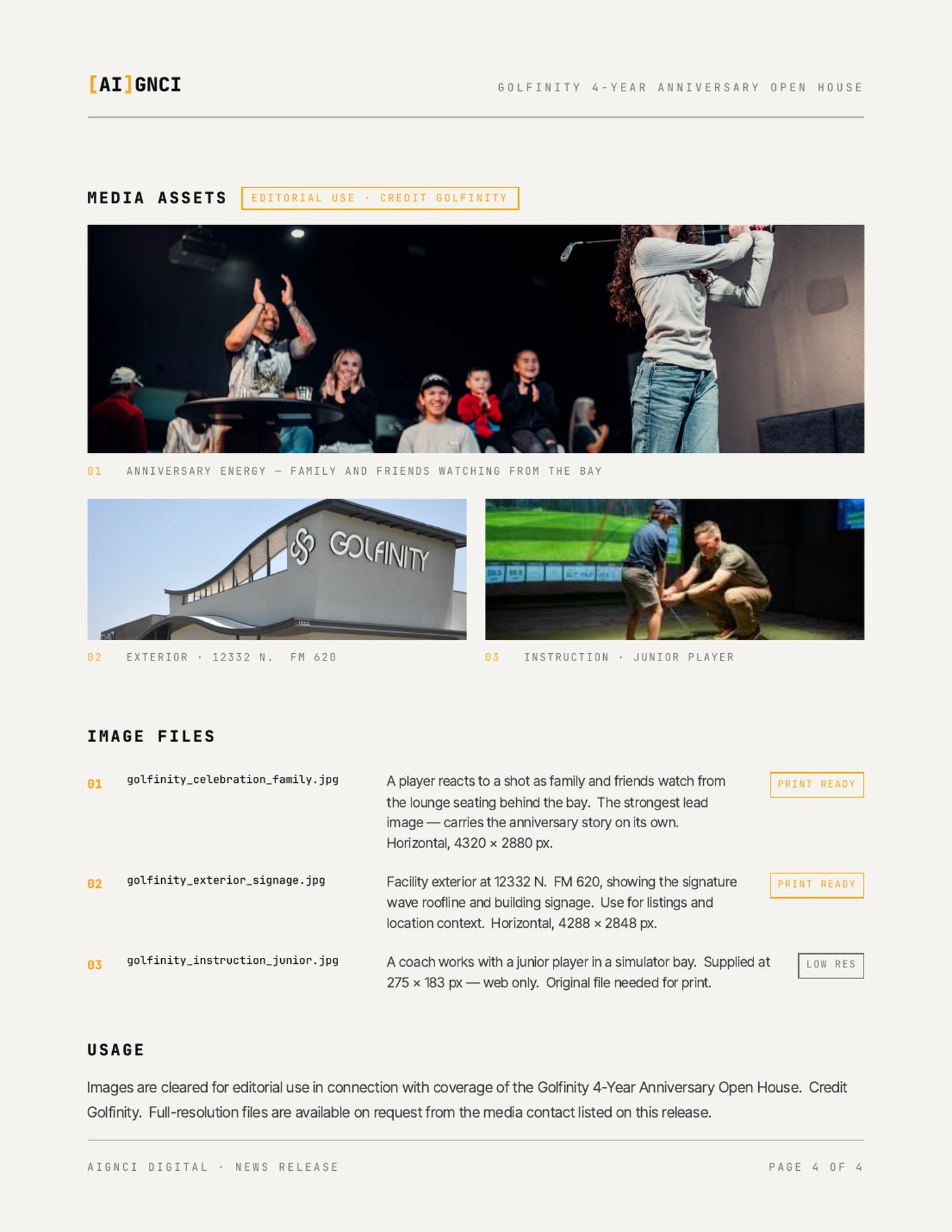
Common questions.
Why does an AEO agency do media relations?
Because answer engines weight third-party corroboration more heavily than first-party claims, and corroboration cannot be marked up into existence. Structured data tells a model what a brand is; earned coverage tells it whether to trust that. AIGNCI Digital runs both because the entity groundwork determines whether a placement is retrievable and attributable at all — a mention the retrieval layer cannot connect back to your organization does very little, regardless of how prestigious the outlet is.
How is this different from traditional PR?
Traditional PR optimizes for reach and reports impressions. Media relations for answer engines optimizes for retrievability and reports citations. The practical differences: the entity and schema foundation is built before outreach rather than never; announcements are published as structured objects on your own domain rather than only through a wire service; and success is measured by whether AI systems cite the coverage when answering questions in your category, tracked monthly against named competitors.
Does a press release still matter for AI search?
A release matters as a source document, not as a distribution event. Wire syndication produces many near-identical copies, which retrieval systems deduplicate and generally discount. What holds value is a canonical, dated announcement page on your own domain carrying correct schema, plus genuine independent coverage that cites it. The release is raw material for both; on its own it is rarely the outcome.
Do you buy links or paid placements?
No. No paid links, no link-insertion networks, no sponsored posts presented as editorial, and no written or arranged reviews. Beyond the policy violations, purchased corroboration is fragile in exactly the channel it is meant to serve, and a reputation practice that buys its own credibility has nothing left to sell.
How do you get an event to show up in AI answers?
Two things together. Event schema on the venue's own page carrying the required fields — name, start and end date and time, location as a resolvable place, an absolute image URL, and admission detail including the free-admission signals — so the event exists as a structured object rather than a sentence in a paragraph. Then dated third-party coverage naming the event, the venue and the date, so the fact is corroborated rather than self-asserted. Structure makes an event retrievable; coverage is what makes an engine willing to name it.
How long before earned coverage affects AI citations?
Publication is fast; retrieval is not. A placement is typically crawlable within days, but appearing inside synthesized answers depends on re-crawl cycles and model refresh, which in practice means four to twelve weeks before a new source influences answers with any consistency. Event coverage is an exception in one direction only: it can be retrieved quickly while the date is live, then loses nearly all value the moment the date passes.
Tell us what you are building.
If the question is about discovery, reputation, a new site, or a market move, send the context. AIGNCI will tell you whether an Audit, a build, or a more focused engagement is the right starting point.