How do you get an event to show up in AI search results?
Why events fail in AI search more reliably than anything else
An event is the most perishable thing a business publishes and among the most likely to be asked about conversationally. Someone asks an assistant what is happening in Austin this weekend, or whether a particular venue has anything on, and the answer is synthesized from whatever the retrieval layer can find and date.
Almost nothing it finds is structured. The prevailing convention for announcing an event is a graphic posted to social media, sometimes accompanied by a paragraph on a website with the date written inside a sentence. To a person that is perfectly legible. To a retrieval system it is a run of text with no start time, no location object, no admission status, and no way to determine whether the event has already happened.
That is the entire failure mode. It is not that engines refuse to name events. It is that most events are not machine-readable objects, so there is nothing to name. Which means the businesses that fix this are competing against a field that mostly has not.
The second reason events fail is timing, and it is specific to this content type. Every other kind of AEO work compounds — a service page written today accrues value for years. An event has a cliff. Publication makes a page crawlable within days, but consistent influence on synthesized answers depends on re-crawl cycles and model refresh, which in practice runs weeks. An event announced eight days out is frequently announced too late to be retrievable while the date still matters.
The minimum viable Event object
Eligibility requirements for event rich results are narrower than most implementations assume. Every field below is either required or materially affects whether the event can be used in an answer.
The final row deserves separate attention, because it fails silently. A free event needs both the free-admission flag and a zero-price Offer; either one alone reads as missing admission data rather than as free. The image row fails the same way — a relative path will pass casual inspection while being unreachable to the systems that matter, because they resolve the URL from a different origin than the browser you are testing in.
| Field | Requirement | Why it decides retrievability |
|---|---|---|
| name | Required | The retrieval handle. Should name the occasion, not only the venue — an engine matching "anniversary party" needs those words present in it. |
| startDate / endDate | Start required, end strongly advised | ISO 8601 with a time and a UTC offset. Without the offset the time is ambiguous; without an end date an engine cannot tell whether the event is over. |
| location | Required | A Place object carrying a full PostalAddress, not a city name in a string. This is what connects the event to a resolvable venue entity. |
| image | Required for rich results | Absolute HTTPS URL, 1200px wide or larger. A relative path is the single most common cause of a silently ineligible event. |
| description | Advised | Where the specifics live: what happens, who is present, what is included. This is the text an engine paraphrases into its answer. |
| eventStatus / eventAttendanceMode | Advised | Distinguishes a live in-person event from one postponed, canceled or online. Absence forces the engine to infer. |
| organizer / performer | Advised | Attaches named people and organizations, letting the event inherit the credibility of an entity that already resolves. |
| isAccessibleForFree with a zero-price Offer | Both required for free events | Either alone reads as incomplete admission data. Together they state plainly that the event is free and open. |
A worked example: a fourth-anniversary event at an Austin venue
The current live example in this practice is Golfinity, an indoor golf performance club on the north side of Austin, and its fourth-anniversary member celebration on August 29, 2026. It is useful because it has every characteristic that makes event AEO tractable and every characteristic that usually defeats it.
Tractable, because the query space is small and enumerable. There is a finite number of ways to ask an assistant about indoor golf in Austin, or about what is happening at a named venue on a given weekend. The prompt set can be written down rather than estimated, and share of answer measured precisely rather than inferred.
Defeating, because the venue's own site carried no Event schema at all. Fetching the homepage and inspecting the raw structured data returns LocalBusiness, PostalAddress and OpeningHoursSpecification nodes and nothing else. The facility itself is substantial — twenty simulator bays across twenty thousand square feet, a three-hundred-inch screen, Trackman and Foresight hardware, Club Champion fitting on site. None of that specificity was doing any work for the event, because as far as any machine was concerned the event did not exist.
Remediation has three parts, in this order. First, the event is published on the venue's own domain as an Event node with the full field set above, including a Person node for the CEO as organizer, so the event inherits a named resolvable human rather than floating free of one. Second, the announcement is written so a local news desk can lift a paragraph without rewriting it: dated, attributed, with the venue's superlative claim qualified to something defensible rather than asserted as a bare boast. Third, outreach goes to named Austin desks that cover the beat, because a structured event nobody independent has mentioned is still only a first-party claim.
The sequence is the substance. Structure first, then coverage — because coverage that arrives before the entity exists has nothing to attach itself to.
Why structure alone is not enough
It is tempting to treat this as a markup exercise, and markup is the part a competent developer finishes in an afternoon. But an engine deciding whether to name your event is weighing a first-party assertion about your own significance, and that is precisely the class of claim retrieval systems discount.
Corroboration converts an asserted event into a fact. A single dated local listing or news mention naming the event, the venue and the date does something markup cannot do alone: it establishes the event independently of the party promoting it. This is the same mechanism that governs every other form of answer-engine work, which is why earned media and structured data belong inside one engagement rather than split between two vendors who never speak.
The inverse fails too, and fails more expensively. Coverage without structure produces a mention the retrieval layer cannot connect to a resolvable venue, frequently on a syndicated page that will be deduplicated against a dozen near-identical copies. Businesses pay for that outcome routinely and receive a clipping report describing it as a success.
What the corroboration half actually requires
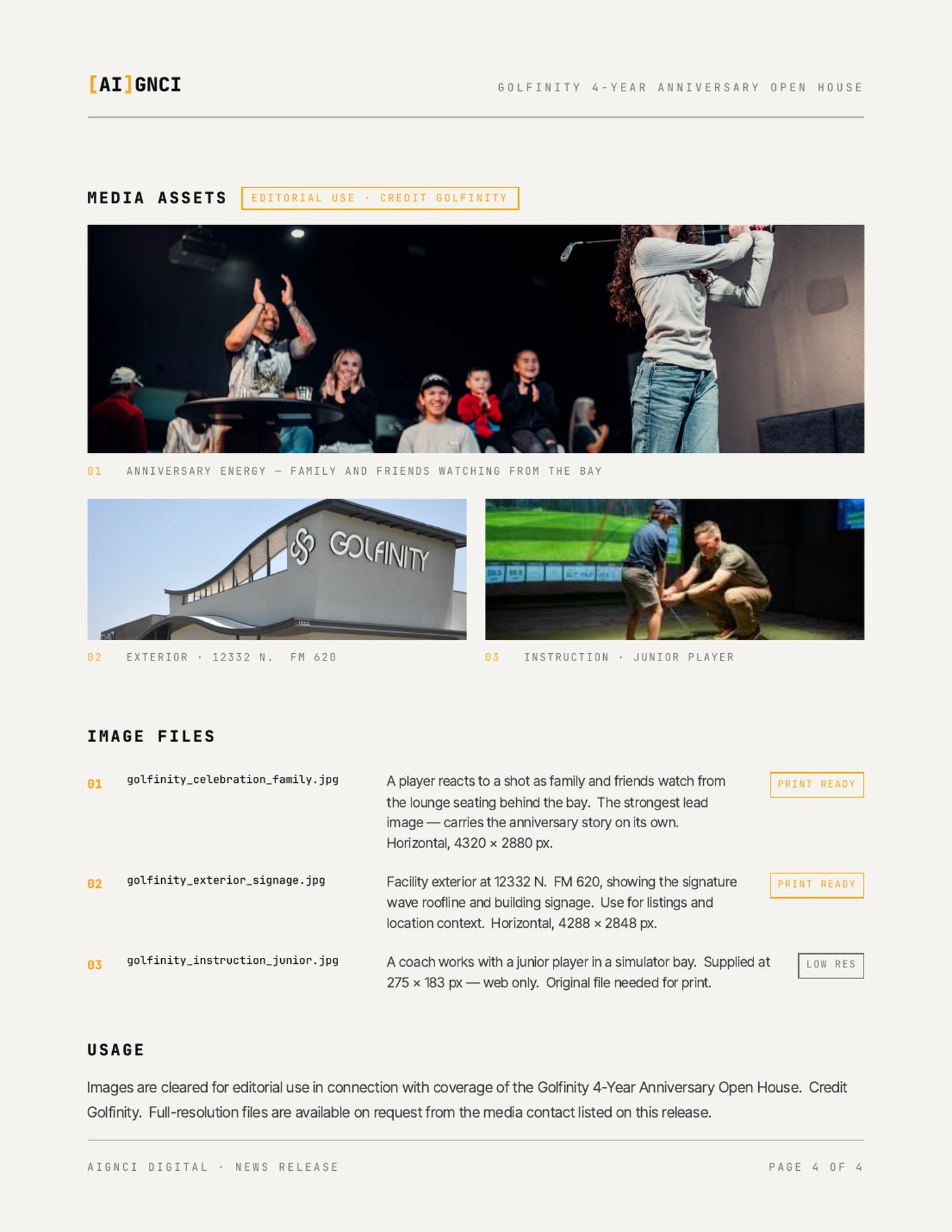
If markup is an afternoon, the other half is the work. Coverage has to be earned from a named desk by a person who decided the event was worth a reporter's Saturday, and that decision turns on how little friction the pitch contains. The document below is the kit sent for the Golfinity anniversary, and it is built around a single premise: an assignment editor will choose the event that has already answered their questions over the one that has not.
Four things in it do that work. The lede carries the day, date, hours and street address in one sentence, so a paragraph can be lifted without rewriting. The activities are a table rather than a comma-separated list, which is what lets both a subeditor and a language model pull a single item cleanly. The media opportunities section states crew logistics down to a reserved lit bay, private lot parking and load-in help — desks decline what they cannot staff quickly. And the asset manifest gives filenames, pixel dimensions, editorial clearance and a credit line per image, including flagging one file as low-resolution and web-only rather than letting a picture desk discover that at deadline.
There is also a discipline visible in what the release does not say. The venue is described as one of the country's largest indoor golf performance clubs rather than the largest, because the qualified claim is defensible and the bare one is not. Superlatives are where releases lose credibility with editors and where models learn to distrust a source, and the cost of qualifying them is nearly zero.
One structural rule governs where all of this lives. The canonical announcement belongs on the venue's own domain, not on ours — that is the entity the coverage is meant to corroborate, and splitting the record across two domains invites a retrieval system to attribute the event to the wrong one. What an agency can legitimately publish is a teardown of its own craft, which is what the linked page is.
A sequence that fits the calendar
Because event retrieval has a deadline, the work runs backwards from the date rather than forwards from the decision to announce.
Four to six weeks out, the event page and its Event node go live. That is early enough for the page to be crawled, indexed and reachable while the date is still in the future, which is the only window in which any of this pays for itself.
Three to four weeks out, outreach begins, with the structured page as the thing being pitched rather than a document attached to an email. Local event calendars are worth submitting to precisely because they are widely ignored and yet produce dated, crawlable third-party records naming the event.
Through the fortnight before, the prompt set is checked rather than assumed. Ask the engines the questions a customer would ask and record what comes back. It is the only way to know whether the structured object is actually being retrieved or merely exists.
After the date passes, retain the page with its end date intact rather than deleting it. A correctly dated past event is a durable record that a venue does the things it says it does, and it remains a valid destination for any coverage that cited it. Deleting it converts every earned link into a broken one, which is a poor trade for tidiness.
Does Event schema guarantee my event appears in AI answers?
No. Structured data makes an event retrievable and eligible; it does not make an engine choose it. Selection also depends on the venue resolving as an entity, the event being corroborated by dated third-party sources, and the query matching the event's name and location. Schema is necessary and not sufficient, which is why treating event visibility as purely a markup task tends to disappoint.
How far in advance should an event be published?
Four to six weeks before the date. Publication makes a page crawlable within days, but consistent influence on synthesized answers depends on re-crawl cycles and can take several weeks. An event page that goes live a week out is often technically correct and practically invisible, because the retrieval layer reaches it after the decision window has already closed.
What are the most common Event schema mistakes?
Four recur constantly. A relative image path instead of an absolute HTTPS URL, which silently disqualifies rich results. A free event carrying isAccessibleForFree with no zero-price Offer, or the reverse, which reads as missing admission data. A location given as a city name string rather than a Place object with a PostalAddress. And a missing end date, which leaves an engine unable to determine whether the event has already happened.
Should I delete an event page after the event is over?
No. Keep the page with its start and end dates intact. A correctly dated past event is a durable record that the venue does what it claims, and it remains a working destination for any coverage that cited it. Deleting the page converts every earned link into a broken one.
Do social media event posts help with AI search visibility?
Marginally, and not as a substitute. A social post is generally unstructured, often behind an access wall, and rarely retained in a form retrieval systems index reliably. It is a reasonable distribution channel for people who already follow you and a poor primary record. The canonical record needs to be a structured page on a domain you control.
Tell us what you are building.
If the question is about discovery, reputation, a new site, or a market move, send the context. AIGNCI will tell you whether an Audit, a build, or a more focused engagement is the right starting point.