Media · Worked example

Anatomy of a press kitbuilt for two readers.

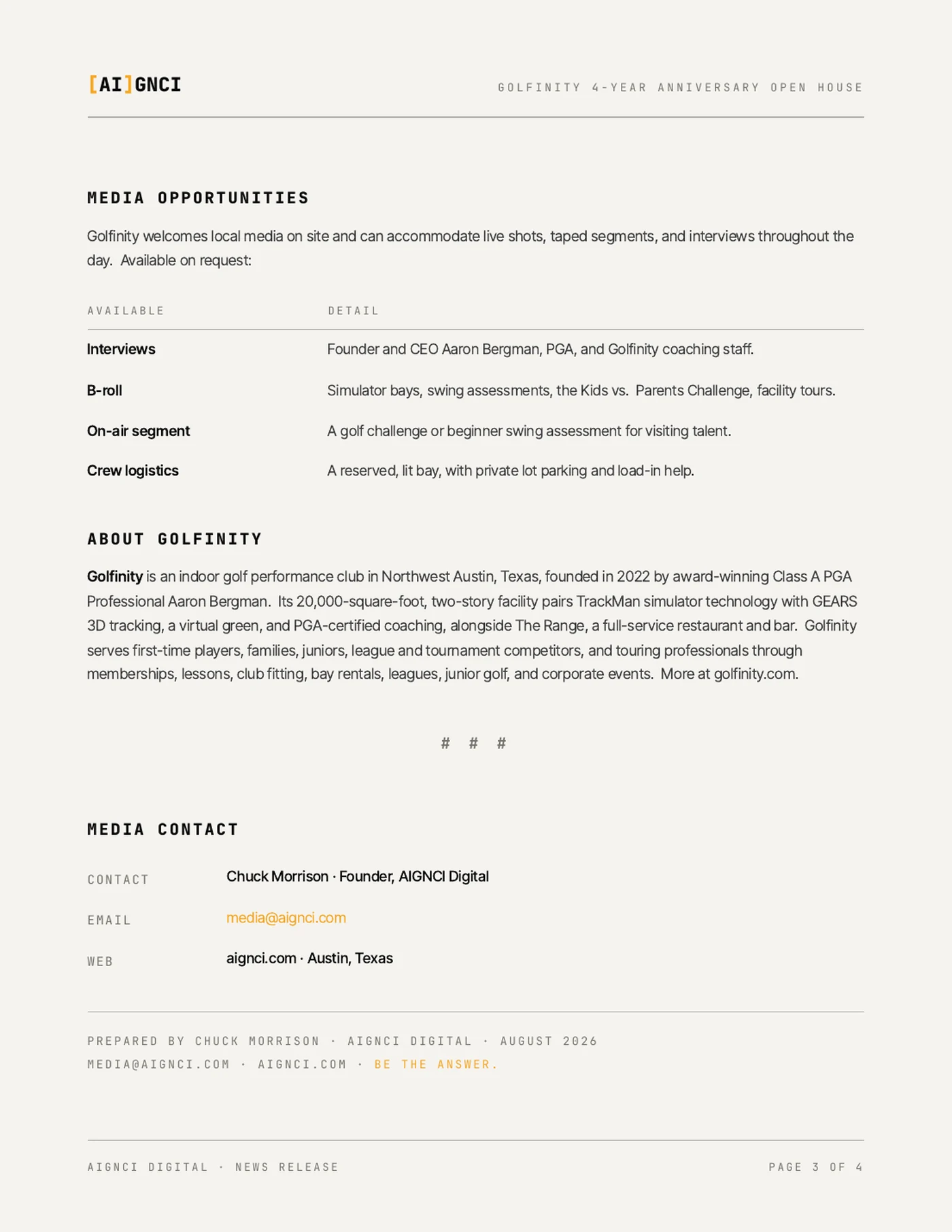
In August 2026 we produced the media kit for Golfinity's fourth anniversary open house. Below is the document taken apart section by section — what each part is for, and which of the two readers it was written for. The announcement itself belongs to the venue and lives on their site.
Client · GolfinityEvent · August 29, 2026Released · August 2026
01Short answer
A press release now has two readers with different needs. A journalist needs a paragraph they can lift without rewriting it, and logistics they can staff by Friday. A retrieval system needs facts it can extract without the surrounding sentence — a date it can parse, a venue it can resolve to a place, an admission price it can state, and a named person it can attribute a quote to. Writing for one and hoping the other copes is the most common failure in the category. The kit below was built for both, and the two requirements turn out to conflict less often than people assume.
02The document

What a desk receives.

Four pages. The announcement and the named quote, the activity and event-detail tables, the media opportunities and boilerplate, and an asset manifest with clearance stated per file. Nothing in it is decorative.
Page 1 · Announcement and quote
Page one of the Golfinity anniversary news release: headline reading Golfinity marks four years with a free community open house, a dateline, the announcement paragraph with date, hours and street address, and a quote attributed to Aaron Bergman, PGA, Founder and CEO
Fig. 01The lede carries day, date, hours and street address in one sentence. The superlative reads 'one of the country's largest' rather than 'the largest' — a claim we can defend is worth more than one we cannot.
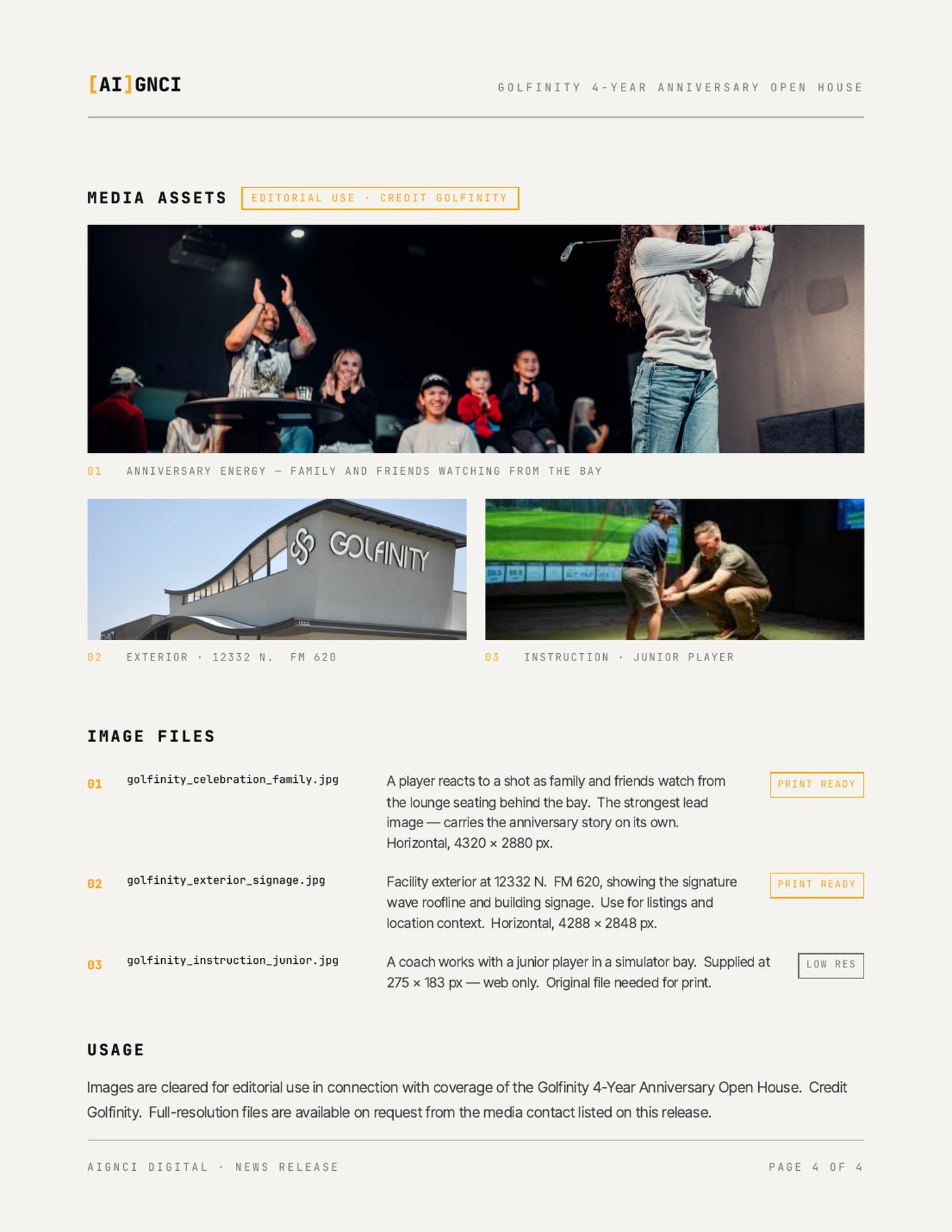
Page 2 · Activities and event details
Page two of the Golfinity release: a seven-row activity table, an event highlights list, and an event details block stating what, when, where, admission and who
Fig. 02Seven activities as table rows, then the event details block. This is the page a retrieval system can actually use, because every fact sits in a labelled cell rather than inside a sentence.
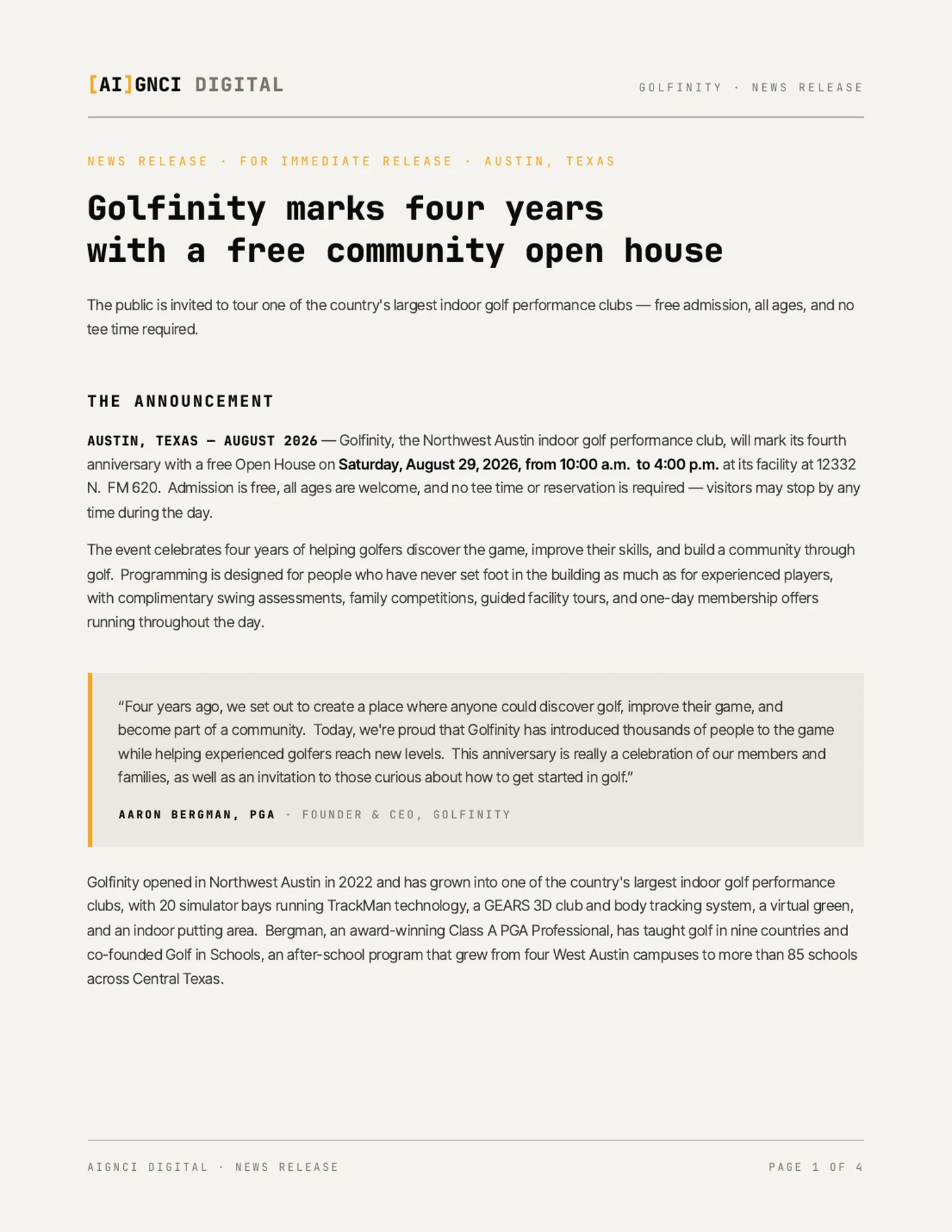
Page 3 · Media opportunities and boilerplate
Page three of the Golfinity release: a media opportunities table listing interviews, B-roll, an on-air segment and crew logistics, followed by the About Golfinity boilerplate and the media contact
Fig. 03Crew logistics stated down to a reserved lit bay, private lot parking and load-in help. An assignment desk declines what it cannot staff quickly, so the friction is removed in advance.
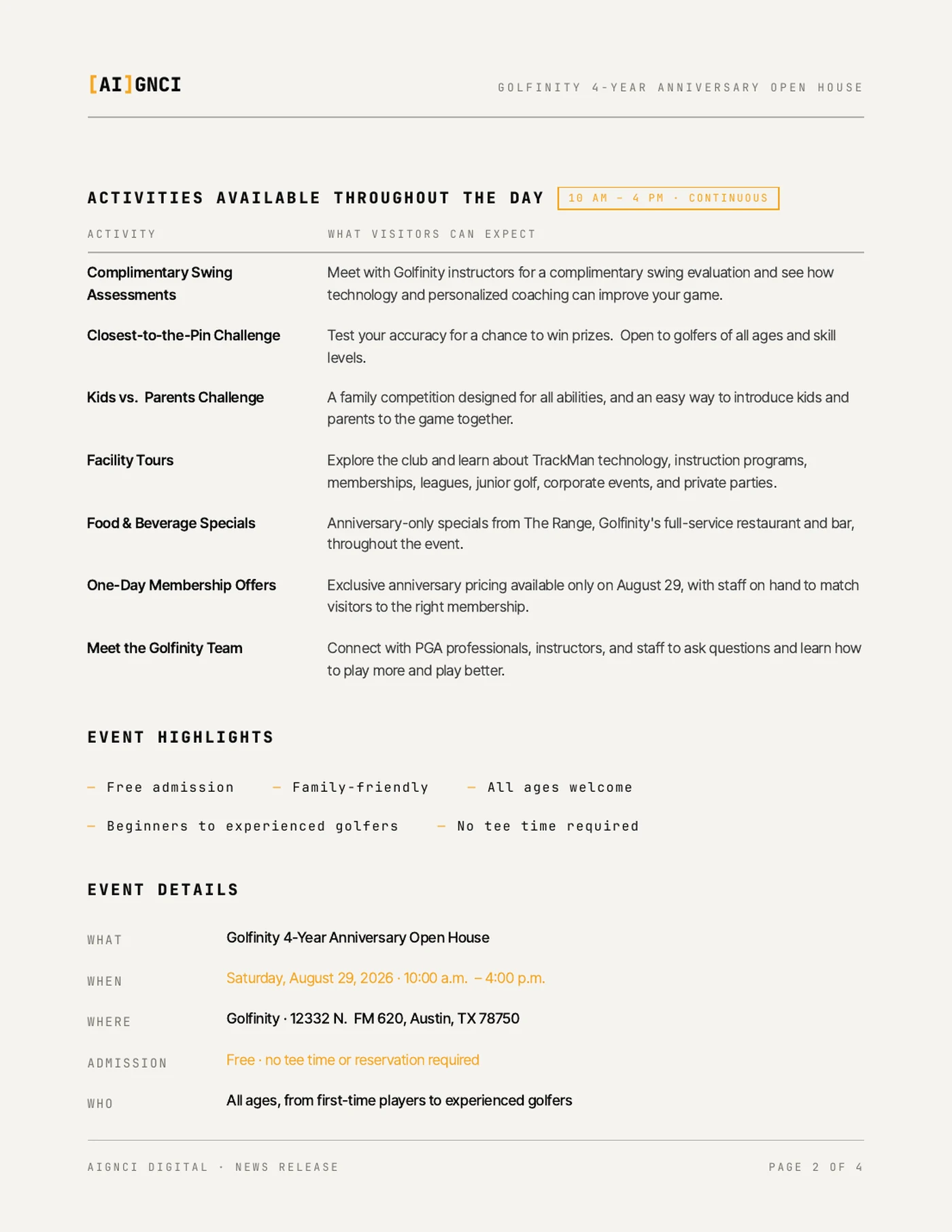
Page 4 · Asset manifest
Page four of the Golfinity release: three credited photographs with a manifest listing filenames, pixel dimensions, editorial clearance, credit line and print-readiness per file
Fig. 04Three images with filenames, dimensions and print-readiness per file — including one flagged low-resolution and web-only, rather than letting a picture desk discover that at deadline.
03Section by section

What each part is for.

The right-hand column is the part most releases skip. Every section earns its place by serving a reader, and where a section serves only the person writing it, it comes out.

SectionJobWhy it is built this way
Headline and standfirstOne retrievable sentenceA model extracting a single clause gets the venue, the occasion, the admission price and the audience without needing the paragraph underneath it.
Dateline and ledeFacts in extractable orderDay, date, hours and street address inside the first sentence, stated once and stated identically everywhere else in the document.
Named quote with titleAttributable claimAaron Bergman, PGA, Founder and CEO — a resolvable person rather than an unnamed spokesperson, so the quote can be attributed and the entity can be linked.
Activity tableStructured detailSeven activities as rows rather than a prose list, because a table survives extraction into an answer where a comma-separated sentence usually does not.
Event details blockThe answer to the questionWhat, when, where, admission and who, labelled explicitly. This block is what a person actually asks an assistant for.
Media opportunitiesLogistics a desk can say yes toInterviews, B-roll subjects, an on-air segment offer, and crew logistics down to a reserved lit bay and load-in help. Assignment desks decline what they cannot staff quickly.
BoilerplateConsistent entity descriptionThe same description of the venue used across every property, so the organization resolves to one entity rather than several near-duplicates.
Asset manifestRemoves the last objectionThree images with filenames, pixel dimensions, editorial clearance, credit line and print-readiness stated per file.
04The structured half

A release is not markup.

A well-written release makes coverage easier to write. It does not, by itself, make an event retrievable. Before this kit went out, inspecting Golfinity's raw structured data returned LocalBusiness, PostalAddress and OpeningHoursSpecification nodes and nothing else. No Event object — which means that to any retrieval system answering a question about what is happening in Austin that Saturday, the event did not exist.

That is the pairing the practice rests on. Structured data makes an occasion retrievable; earned coverage makes it corroborated. Either one alone underperforms, and the two are commissioned as a single piece of work rather than as a technical task followed by a publicity task.

Two details account for most failures we see. Free admission has to be declared twice, once through the accessibility flag and once as a zero-price offer, because engines read the two differently and a single signal is frequently ignored. And a relative image path silently disqualifies the rich result — the URL has to be absolute. The Event node on this page states both correctly, since a page making the argument should not commit the error.

The full field list, with the two nobody gets right
Published state
Event
Dated object with start and end times
Place
Venue resolvable to a street address
Offer
Zero price, stated explicitly
Accessibility
Free-admission flag, set alongside the offer
Image
Absolute URL, never a relative path
Organizer
Named organization, linked to its own domain
05Honest limits

What this does not prove yet.

The kit shipped in August 2026 and the event falls on August 29. What exists today is a well-constructed document and a specified schema layer — a method, not a result. Coverage secured and share-of-answer movement on Austin indoor-golf prompts will be published after the date, with figures, or not published at all. We would rather show the construction now and the outcome when it exists than describe an outcome that has not happened.

06Questions

Should a press release live on the agency's website?

No. The canonical announcement belongs on the client's own domain, because that is the entity the coverage is meant to corroborate and the URL a retrieval system should associate with the event. What an agency can legitimately publish is a teardown of its own work — this page explains how the Golfinity release was constructed and why, and links to the venue for the announcement itself. Hosting a client's news on an agency domain splits the signal across two entities and invites the retrieval layer to attribute the event to the wrong one.

What makes a press release retrievable by an AI system?

Facts stated once, stated identically, and placed where extraction is cheap. In practice that means the who, what, when, where and admission price inside the first sentence rather than the fourth paragraph; tables instead of comma-separated lists for anything enumerable; a named person with a title on every quote; superlatives either sourced or qualified so a model is not asked to repeat an unverifiable claim; and a dated, canonical version on the subject's own domain carrying the matching structured data.

Does a media asset manifest actually matter?

It matters to the human decision, which still gates the coverage. An assignment editor deciding between two events on the same Saturday will choose the one that already answers whether images are cleared for editorial use, what credit line to run, whether the file is print-resolution, and whether a crew can be accommodated on site. The Golfinity kit states all four per file, including flagging one image as low-resolution and web-only rather than letting a picture desk discover that at deadline.

Does the release itself get cited in AI answers?

Rarely, and it is the wrong thing to optimize for. Wire syndication produces many near-identical copies that retrieval systems deduplicate and generally discount. The release's job is to be raw material — it makes independent coverage easier to write, and that coverage is what gets cited. The structured Event node on the venue's own domain is what makes the occasion retrievable directly.
Next step

Have something worth announcing?

Most announcements are published as a graphic on social and nowhere else — legible to a person, invisible to a retrieval system. If you have an event, a launch or a milestone coming, the structure and the outreach should be commissioned as one piece of work. Tell us what is on the calendar.