Win the search.
The buyer typically moved among search results, business sites, reviews, directories, social channels and content before assembling an answer for themselves.
The job: earn a credible place in the buyer's research path.
The buyer typically moved among search results, business sites, reviews, directories, social channels and content before assembling an answer for themselves.
The job: earn a credible place in the buyer's research path.
An AI answer can now surface facts, compare options, summarize the tradeoffs, recommend a provider and direct the buyer to a next action before a traditional click.
The job: make the business fit for the full decision path, not only the ranking.
The 2024-to-2026 comparison is an AIGNCI framing model. It describes the commercial change this page addresses; it is not a claim that every buyer follows a fixed path or that every AI product operates the same way.
Reach, Read and Cite remain the foundation. Recommend and Act make the commercial outcome explicit: whether the company makes the choice set, and whether a buyer can move forward.
Bot rules, render paths, redirects and delivery policy decide whether public facts are available before the content itself has a chance to matter.
Access
Important information has to be present, structured, current and clear enough to be extracted without guessing or contradiction.
Absorption · accuracy
A clear page is necessary but not always sufficient. The wider public record has to support the company’s identity and claims.
Mention · citation · source authority
A buyer may ask who is best, most trusted, comparable, or right for the job. The commercial question is not only whether the company is visible, but how it is framed.
Recommendation
The answer should lead to a practical next step: visit, call, inquiry, purchase, booking or another task the buyer is ready to complete.
Action
These five stages are AIGNCI's operating framework, not a claim that answer engines disclose or use this precise internal sequence. They provide a disciplined way to identify where an externally visible decision path breaks.
The research does not say every buyer skips a website, every answer leads to a decision, or every platform behaves identically. It does show that AI use and AI-generated search summaries are now material parts of how information is reached and how clicks occur.
Read the September evidence briefof U.S. adults reported using at least one AI platform in the past week.
Nationally representative sample of approximately 1,000 U.S. adults age 18+; fielded May 14–18, 2026.
Edison Research at SSRS · May 2026share of visits that produced a traditional Google result click when an AI summary appeared versus when one did not.
Observed among 900 consenting U.S. adults who shared browsing activity in March 2025.
Pew Research Center · July 2025share of AI-summary visits in Pew’s study that resulted in a click on a cited source inside the summary.
Observed among 900 consenting U.S. adults who shared browsing activity in March 2025.
Pew Research Center · July 2025of all Google searches in Pew’s March 2025 study generated an AI summary.
Observed among 900 consenting U.S. adults who shared browsing activity in March 2025.
Pew Research Center · July 2025Rankings and sessions still count. They no longer explain whether the business entered the answer, was understood accurately, made the comparison, or enabled the next action.
Is the brand in the answer?
Is it named as a source?
Is its evidence understood?
Is it preferred?
Is it represented correctly?
Are its sources trusted?
Does the answer lead forward?
This is the original AIGNCI one-page visual. Open it at full size, download the image, or send it to someone who needs the plain-English version of what changed.
Built to be shared in a meeting, proposal, email, or social post. Please retain the AIGNCI Digital attribution shown on the visual.
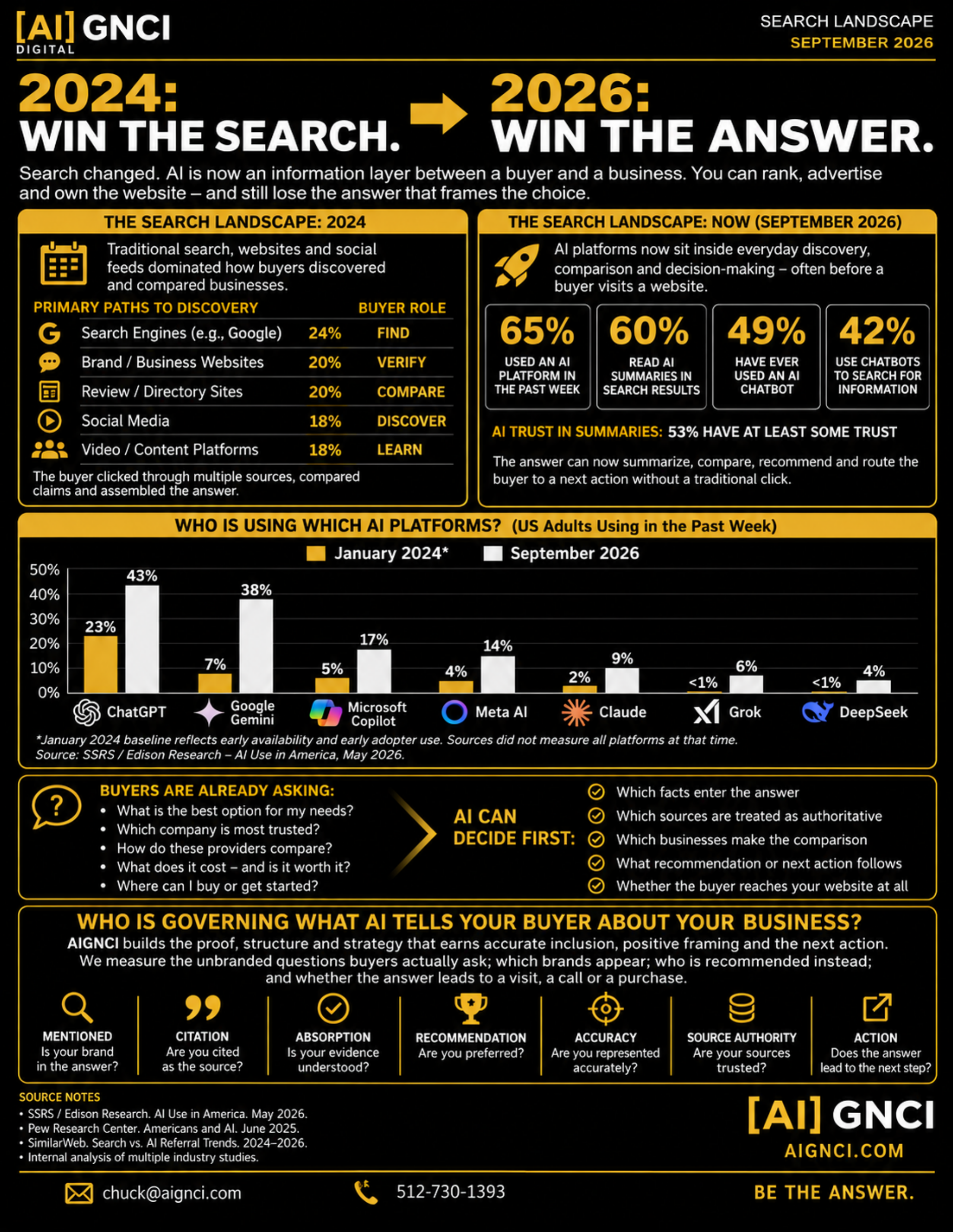
The full visual is shown above and is available to download and share. This page is the accessible, crawlable version: its framework is labeled as AIGNCI's, and its reported research is separated from AIGNCI analysis with a link to the original publisher.
Open the one-page PDFStart with a public baseline. AIGNCI will identify whether the visible break is reach, clarity, citation, recommendation or the next action—and what can be verified from public evidence.