FabriCare of Greenville
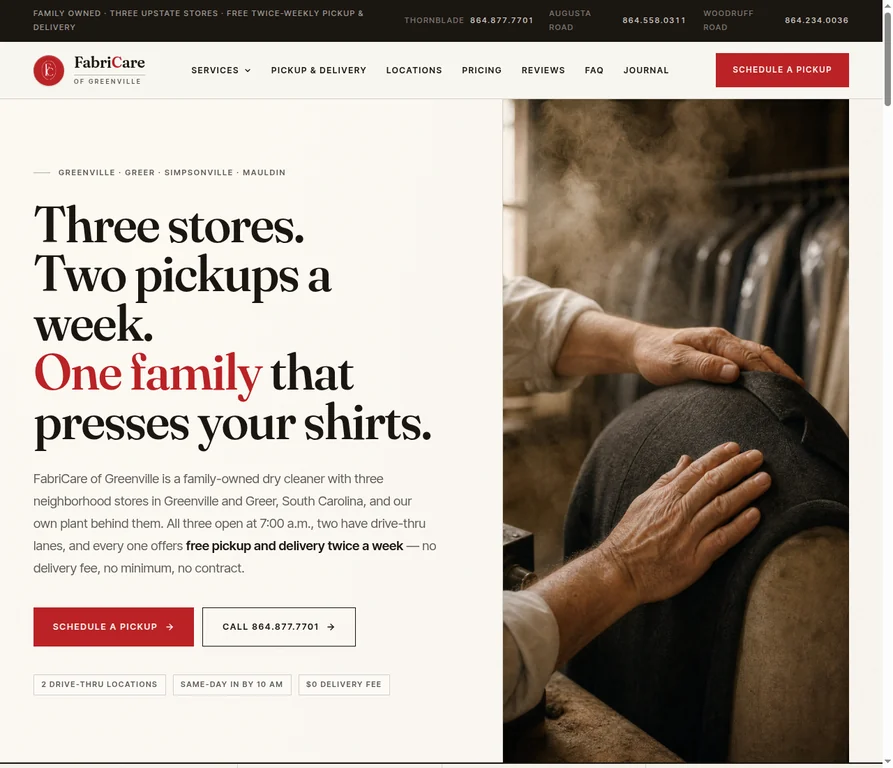
The previous site was a template build, and it failed at the most basic level of machine legibility: it disagreed with itself. Body copy said the company had two locations to serve you while the footer listed three. Copy naming the stores had the two cities reversed, placing Thornblade in Greenville and Augusta Road in Greer when the reverse is true. A retrieval system reading that page cannot decide how many stores exist or where they are, and an assistant that cannot resolve a location does not recommend it.
The logo link text on every page read FabriCare Of GreenVille Proessional Drycleaners — a typo in the site's own name, in the highest-authority text on the page. Entity resolution starts with a machine being able to establish what a business is called.
The hero was a Vimeo iframe. The primary visual argument for a local service business was delegated to a third-party embed, which means the thing a crawler receives first is a player, not a proposition.
Page inventory was thin against the way people actually search: no FAQ, no pricing page, no city-level pages, and store hours duplicated several times over in the rendered output. Eight distinct services were compressed into one services page, and six delivery cities were addressed as a comma-separated list rather than as places anyone could ask about by name.
None of this was unusual, and that is the point. This is what a competent small-business template site looks like in 2026, and it is why local operators with genuinely better businesses lose the answer to competitors with worse ones.
AIGNCI rebuilt our site from the ground up and resolved a long list of technical and data errors our old one had been carrying for years — including copy that contradicted itself about how many stores we have. What we have now is focused on what our family actually does: dry cleaning, wash and fold, and free pickup and delivery, with a real page for every service and every town we serve rather than one list that mentioned them in passing. AIGNCI understood the business before touching the website. Extremely pleased with the entire process.
Which stages applied, and what they produced.
Map
Inventoried what customers actually ask before choosing a dry cleaner — what it costs, how long it takes, whether there is a delivery fee, whether same-day is possible, whether you have to be home for a pickup — and treated each as a page-level obligation rather than a paragraph in an About section.
Ground
Every operational fact verified against the business rather than inferred: three addresses, three phone numbers, per-store hours, which two of the three stores have drive-thru lanes, the $8.95 rush fee, and the two-to-three day standard turnaround. Structured as DryCleaningOrLaundry with PostalAddress, GeoCoordinates, OpeningHoursSpecification and per-store LocationFeatureSpecification.
Structure
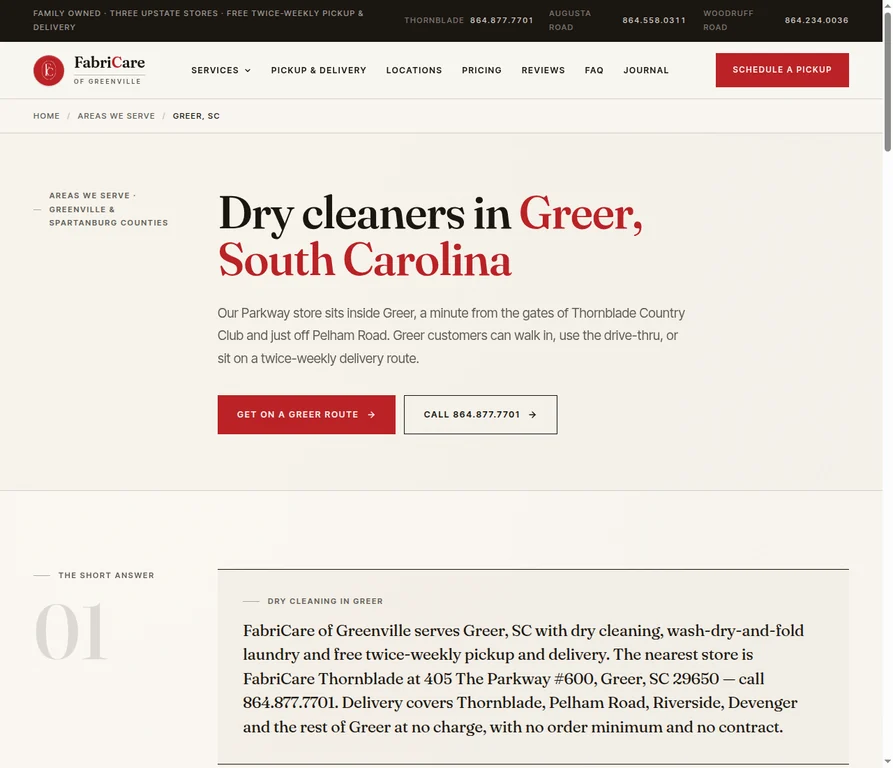
Thirty-nine pages: eight service pages, six city pages, three store pages, plus pricing, FAQ, reviews, journal and the transactional schedule-a-pickup route. Each city page opens with a short answer naming the nearest store, its address and its phone number, so the answer to a location question is retrievable in one paragraph.
Corroborate
Reviews given a dedicated surface, three social profiles connected as sameAs references, and the same NAP facts aligned across the site, the stores and the profiles so a machine reading any one of them arrives at the same business.
Compound
A journal seeded with seven answer-first articles built from real query language — how often a suit should be dry cleaned, how to preserve a wedding dress, dry cleaning versus wash and fold — so the site keeps accumulating retrievable answers rather than sitting static.
Stage names refer to The Citation Engine
The service-by-city matrix is the structural argument of this build. Eight services and six cities is forty-eight potential intersections, and the near-universal small-business pattern is to publish an areas we serve list and hope a machine infers the rest. Inference is exactly what retrieval systems will not do on your behalf. A person asking an assistant for a dry cleaner in Greer is asking a narrow question, and the site now has a page whose entire job is to answer it — naming Thornblade at 405 The Parkway, its phone number, its drive-thru, and the specific neighborhoods the twice-weekly route covers.
The pricing page is the most instructive decision on the site, because it publishes an honest refusal. FabriCare does not have a price list — cost follows the garment rather than the category, since a lined silk dress is not a cotton one and two suits can price differently. The weak options were to invent a list or to omit the page. Both lose: the first is inaccurate, the second leaves the highest-volume question in the category unanswered. The page instead answers what dry cleaning costs in Greenville by explaining what drives the price and committing to a quote before work starts. An assistant can repeat that answer without misleading anyone, which is the only test that matters.
Answer-first FAQ blocks appear on the homepage and on every city page rather than being quarantined on a single FAQ route. The questions are the ones a person actually types or speaks — is there a delivery fee, do I have to be home, do you have a drive-thru — and each answer is complete in isolation, which is what allows it to be lifted. The delivery answer is a good example of specificity beating adjectives: no delivery fee, no fuel surcharge, no order minimum, no contract, and delivery customers pay the same per-item price as walk-ins. Four constraints and a price-parity claim, all checkable.
Facts do more work than atmosphere in this category. All three stores open at 7:00 a.m. Two have drive-thru lanes. Same-day is in by 10:00 AM and back by 5:00 PM for a flat $8.95. Wedding gown preservation runs two to four weeks and leather two to three, because both go to specialists. Each of those is a sentence a model can retrieve and repeat with confidence, and collectively they distinguish the business from a competitor whose site says it offers quality service and fast turnaround.
One architectural note stated plainly, because the standard applied to client work is the standard applied here: structured data on the new site is injected at render rather than served in the initial HTML response. Google renders JavaScript and reads it correctly. Several AI crawlers do not, and the honest position is that this is the site's remaining weakness rather than a solved problem. Moving the entity graph into the served response is scoped work, not a defect discovered late — and naming it is more useful to a prospect than claiming a clean sweep.
The sitemap declares the www hostname while the site currently serves the apex. Both resolve and one redirects to the other, so nothing is broken, but a sitemap should declare the host that actually answers. It is a one-line correction and it is on the list.
Before & After: FabriCare Information Architecture
- Indexed pages1 (Single list)
- Location accuracyContradictory (Reversed cities)
- Service inventory8 services compressed in 1 tab
- Entity disambiguationNone (Vimeo hero, typo in logo)
- Indexed pages39 purpose-built pages
- Location accuracy3 Verified Store Nodes
- Service inventory8 Dedicated Service Routes
- Entity disambiguationFull Schema & SameAs Graph
Greenville & Greer Verified Store & Delivery Nodes
Thornblade Store
405 The Parkway
Augusta Road Store
1829 Augusta Road
Woodruff Road Store
1140 Woodruff Road
- Engagement type
- Full AEO-native rebuild, multi-location local
- Schema
- DryCleaningOrLaundry · Service · OfferCatalog · FAQPage · BlogPosting · BreadcrumbList · LocationFeatureSpecification
- Architecture
- 8 services × 6 cities × 3 stores, individually addressed
- Answer surfaces
- Homepage FAQ · per-city FAQ · pricing · 7-post journal
- Replaced
- Template build with a Vimeo hero and self-contradicting location copy
The rebuild went live on the client's domain in August 2026. Ranking and citation movement will be published once a full measurement cycle has completed on the live domain — the figures above describe what was built, not what it has since earned.
RelationshipThe previous site was built by an outside agency with no connection to AIGNCI. Naming permission for this case study was granted by the client.
Continue throughthe evidence.
Tell us what you are building.
If the question is about discovery, reputation, a new site, or a market move, send the context. AIGNCI will tell you whether an Audit, a build, or a more focused engagement is the right starting point.